

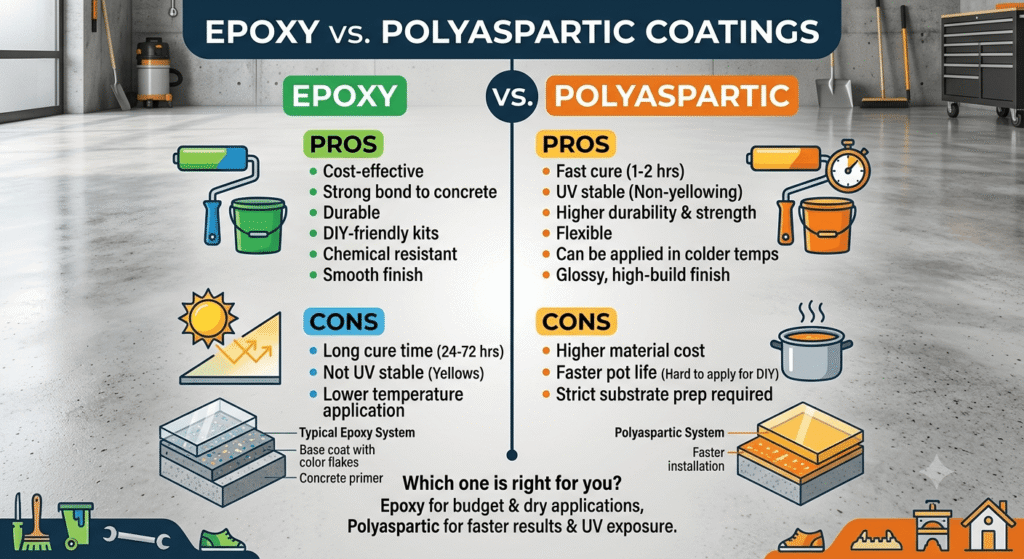
If you’re planning to upgrade your garage floor, you’ve probably come across the debate of Epoxy vs. Polyaspartic coatings. Both are excellent flooring solutions, but choosing the right one depends on your budget, garage usage, and especially Florida’s hot and humid climate.
Florida homeowners face unique challenges such as high humidity, UV exposure, heavy rain, and fluctuating temperatures. A garage floor coating that performs well in northern climates may not necessarily be the best option for Florida.
In this comprehensive guide, we’ll compare Epoxy vs. Polyaspartic in terms of durability, installation, appearance, maintenance, cost, lifespan, and overall performance so you can confidently choose the right garage floor coating.
Table of Contents
Why Garage Floor Coatings Matter
Your garage floor experiences daily abuse from:
- Hot vehicle tires
- Oil and chemical spills
- Moisture
- Dirt and sand
- Heavy equipment
- UV exposure
Bare concrete absorbs moisture, stains easily, develops cracks, and creates dust. A professional floor coating protects your investment while improving the appearance and functionality of your garage.
What Is Epoxy Flooring?
Epoxy is a resin-based floor coating created by combining resin and hardener. Once cured, it forms a hard, durable protective layer over concrete.
For decades, epoxy has been one of the most popular garage flooring systems because it offers excellent protection at an affordable price.
Benefits of Epoxy
- Affordable installation
- Attractive glossy finish
- Wide range of colors
- Decorative flakes available
- Strong chemical resistance
- Good impact resistance
- Easy to clean
However, epoxy does have limitations, especially in Florida’s climate.
What Is Polyaspartic Flooring?
Polyaspartic is an advanced coating technology developed from polyurea. It has quickly become the preferred option for premium garage floor installations.
Unlike epoxy, polyaspartic coatings cure much faster and provide superior UV resistance.
Professional installers throughout Florida increasingly recommend polyaspartic because it performs exceptionally well in hot, humid environments.
Benefits of Polyaspartic
- UV stable
- Fast curing
- Highly flexible
- Excellent abrasion resistance
- Better moisture resistance
- Long lifespan
- Superior chemical resistance
Epoxy vs. Polyaspartic: Side-by-Side Comparison
| Feature | Epoxy | Polyaspartic |
|---|---|---|
| Installation Time | 2–4 days | Usually 1 day |
| UV Resistance | Poor | Excellent |
| Heat Resistance | Good | Excellent |
| Moisture Resistance | Moderate | Excellent |
| Flexibility | Low | High |
| Chemical Resistance | Very Good | Excellent |
| Lifespan | 8–15 years | 15–20+ years |
| Maintenance | Easy | Very Easy |
| Cost | Lower | Higher |
| Best for Florida | Good | Excellent |
Epoxy vs. Polyaspartic: Durability
One of the biggest deciding factors is durability.
Epoxy
Epoxy creates a hard surface but tends to become brittle over time. Constant expansion and contraction from Florida’s temperature changes can eventually cause cracking.
Heavy impacts may also chip epoxy.
Polyaspartic
Polyaspartic is more flexible.
Instead of cracking under pressure, it expands and contracts with the concrete, making it ideal for Florida homes.
Winner: Polyaspartic
Which Coating Handles Florida Heat Better?
Florida garages often exceed 100°F during summer.
High temperatures combined with humidity place significant stress on floor coatings.
Epoxy
Epoxy performs reasonably well but prolonged UV exposure can cause:
- Yellowing
- Fading
- Chalky appearance
Polyaspartic
Polyaspartic is completely UV stable.
It maintains its color and gloss even after years of direct sunlight.
Winner: Polyaspartic
Moisture Resistance
Florida’s humidity makes moisture protection extremely important.
Concrete naturally absorbs water vapor.
Epoxy
Moisture trapped beneath epoxy may eventually cause:
- Bubbling
- Peeling
- Delamination
Polyaspartic
Polyaspartic bonds more effectively with concrete and offers better moisture resistance.
Winner: Polyaspartic
Installation Time
Most homeowners don’t want their garage out of service for several days.
Epoxy Installation
Typical installation:
- Surface preparation
- Primer
- Base coat
- Decorative flakes
- Top coat
- Cure time
Total time:
2–4 days
Vehicle traffic may require waiting up to 7 days.
Polyaspartic Installation
Polyaspartic cures rapidly.
Many professional installers complete the entire project in one day.
You can often park your vehicle within 24 hours.
Winner: Polyaspartic
Appearance
Both coatings provide beautiful finishes.
Epoxy Options
- Solid colors
- Metallic finishes
- Decorative flakes
- High gloss
- Satin finish
Polyaspartic Options
- Decorative flakes
- Quartz systems
- Multiple colors
- High gloss
- Matte finishes
In terms of appearance, both look outstanding.
Winner: Tie
Scratch Resistance
Garages experience constant wear from:
- Tires
- Toolboxes
- Lawn equipment
- Bikes
- Storage shelves
Polyaspartic generally offers better abrasion resistance.
It resists scratches more effectively than epoxy.
Winner: Polyaspartic
Chemical Resistance
Garage floors often come into contact with:
- Motor oil
- Brake fluid
- Gasoline
- Battery acid
- Cleaning chemicals
Both coatings resist chemicals well.
Polyaspartic has a slight advantage because it maintains its protective properties longer.
Maintenance Requirements
Both coatings require minimal maintenance.
Simply:
- Sweep regularly
- Mop occasionally
- Clean spills promptly
Unlike bare concrete, coated floors won’t trap dust.
Maintenance is essentially the same.
Winner: Tie
Lifespan
A professionally installed garage floor is an investment.
Epoxy
Average lifespan:
8–15 years
Polyaspartic
Average lifespan:
15–20+ years
With proper care, premium polyaspartic floors can last even longer.
Winner: Polyaspartic
Cost Comparison
One of the biggest differences in the Epoxy vs. Polyaspartic debate is price.
Epoxy
Lower upfront investment.
Ideal for homeowners on a budget.
Polyaspartic
Higher installation cost.
However, the longer lifespan often results in better long-term value.
Which Is Better for Florida?
Florida presents unique environmental conditions:
- High humidity
- Salt air
- Heavy rainfall
- Strong sunlight
- High temperatures
Polyaspartic was practically designed for these conditions.
Its UV stability and moisture resistance make it one of the best garage floor coating systems available.
Pros and Cons
Epoxy Pros
- Lower cost
- Attractive appearance
- Strong protection
- Excellent adhesion
- Wide variety of colors
Epoxy Cons
- Longer installation
- Can yellow in sunlight
- More prone to cracking
- Less flexible
Polyaspartic Pros
- UV resistant
- Fast installation
- Long lifespan
- Flexible
- Excellent chemical resistance
- Better for Florida weather
Polyaspartic Cons
- Higher upfront cost
- Requires experienced installers
Which Garage Owners Should Choose Epoxy?
Epoxy may be the better choice if:
- You’re on a tighter budget.
- Your garage receives minimal direct sunlight.
- You don’t mind a longer installation time.
- You want an attractive floor at a lower cost.
Who Should Choose Polyaspartic?
Polyaspartic is ideal if:
- You live in Florida.
- You want maximum durability.
- Your garage receives direct sunlight.
- You prefer a one-day installation.
- You’re looking for long-term value.
- You want the best resistance to moisture, UV rays, and heavy use.
Frequently Asked Questions
Is polyaspartic worth the extra cost?
Yes. While it costs more initially, its longer lifespan, faster installation, and superior resistance to UV rays and moisture make it a worthwhile investment for many Florida homeowners.
Does epoxy crack?
It can. Over time, epoxy may crack if the concrete shifts or expands due to temperature changes.
Does polyaspartic yellow?
No. One of its biggest advantages is excellent UV stability, meaning it resists yellowing even under direct sunlight.
Can I park my car immediately?
- Epoxy: Usually requires several days before vehicle traffic.
- Polyaspartic: Often ready for vehicles within 24 hours.
Which coating lasts longer?
Polyaspartic generally lasts 15–20+ years, while epoxy typically lasts 8–15 years with proper maintenance.
Final Verdict: Epoxy vs. Polyaspartic
When comparing Epoxy vs. Polyaspartic, both coatings offer excellent protection and improve the look of your garage. However, the best choice depends on your priorities.
If affordability is your main concern, epoxy provides a durable, attractive finish at a lower upfront cost.
If you want the highest level of performance, especially in Florida’s hot, humid, and sunny climate, polyaspartic is the superior option. Its fast installation, exceptional UV stability, moisture resistance, flexibility, and longer lifespan make it a smart long-term investment.
For most Florida homeowners, polyaspartic is the clear winner, delivering lasting protection and outstanding value for your garage floor.